• Skip to primary navigation
  • Skip to main content

Center for Infrastructure, Transportation, and the Environment (CITE)

Rensselaer Polytechnic Institute SEARCH
School of Engineering
Center for Infrastructure, Transportation, and the Environment (CITE)
  • About Us
  • Team
  • News
  • Training & Outreach
  • Research
  • Software & Tools
  • CoE-SUFS
    • Peer-to-Peer Exchange Program
  • Contact Us

Research

Remote Sensing Decision Support System for Optimal Access Restoration in Post Disaster Environments

October 16, 2019 By admin

Remote Sensing Decision Support System for Optimal Access Restoration in Post Disaster Environments

START YEAR:

COMPLETION YEAR: 2017

TOPIC(S): Disaster Response

PRIMARY CONTACT(S):

  • José Holguín-Veras

PARTNER(S):

  • New York City Department of Transportation (NYCDOT)
  • Rochester Institute of Technology (RIT)

SPONSORS/FUNDING:

  • U.S. Department of Transportation
Remote Sensing Decision Support System for Optimal Access Restoration in Post Disaster Environments Project

OVERVIEW

The project’s main goal is to develop a state-of-the-art Decision Support System (DSS) that, using network condition and disaster impact assessments provided by Commercial Remote Sensing (CRS), will compute optimal Access Restoration Plans (ARP). This will help responders optimally use their scarce resources to orchestrate the road openings, road repairs, and other similar actions; and subdivide the work so that multiple groups could seamlessly cooperate to reach maximum effectiveness. The DSS will process multi-modal temporal data feeds (GIS, social media feeds, etc.) to update estimates of disaster impacts, and will use modern optimization procedures to update the ARP as new data becomes available. To achieve the overall goal, the team will collaborate to:

  • Develop a Commercial Remote Sensing (CRS) Module that allows emergency response personnel and planners to produce rapid and accurate assessments of network conditions and disaster impacts by integrating multi-modal/multi-temporal data
  • Develop an Optimization Module and the Decision Support System (DSS) to produce an Optimal Access Restoration Plan using appropriate priority metrics
  • Create a DSS that is smoothly transitioned to practice, fully validated, and useful to responders. These tasks will ensure that the DSS meets the expectations of the end users, in terms of ease of use, quality of results, and usefulness. This will be accomplished by means of creating a Technical Advisory Council, a vigorous process of outreach and validation, and a solid process of training and transition to implementation
  • Develop appropriate procedures for integration of multiple responder groups. This objective seeks to facilitate the integration of multiple responder groups (such as nearby DOTs that send equipment like plow trucks and loaders to help the effort) to the overall effort of access restoration

KEY TASKS

  • Assessment of the CRS technologies for use on debris and flood classification
  • Development of algorithms for location, classification, and quantification of debris/flood occurrences
  • Development of procedures to integrate multi-modal/temporal data to assess disaster impacts
  • Development of algorithms and scripts to geo-locate estimates of network conditions and disaster impacts
  • Review, evaluate, and select applicable priority metrics
  • Develop and improve the Optimization Module
  • System Integration of the CRS and Optimization Modules to create the Decision Support System (DSS)
  • Creation of Technical Advisory Council (TAC)
  • Review current practices

KEY FINDINGS

  • Developed CRS technologies to implement algorithms to detect obstructions to the roadway
  • Considered 5 different metrics (population, private cost, time, deprivation time and cost, and social costs)
  • Recognize that each metric could lead to different results
  • Suggest procedures to let the users of the DSS select the most appropriate metric

KEY PRODUCTS

  • Final Report
  • Access Restoration Planning (ARP) Software

ADDITIONAL PRODUCTS

CONTRIBUTING TEAM MEMBERS

  • Felipe Aros-Vera

RELATED PROJECTS

Cyber Enabled Discovery System for Advanced Multidisciplinary Study of Humanitarian Logistics for Disaster Response

October 16, 2019 By admin

Cyber Enabled Discovery System for Advanced Multidisciplinary Study of Humanitarian Logistics for Disaster Response

START YEAR: 2012

COMPLETION YEAR: 2017

TOPIC(S): Disaster Response, Network Modeling

PRIMARY CONTACT(S):

  • José Holguín-Veras

PARTNER(S):

  • University of Delaware
  • Virginia Polytechnic Institute

SPONSORS/FUNDING:

  • National Science Foundation Information and Intelligent Systems (NSF-IIS)
Remote Sensing Decision Support System for Optimal Access Restoration in Post Disaster Environments Project

OVERVIEW

This project is concerned with the development of an integrative “Cyber Enabled Discovery System for Advanced Multidisciplinary Study of Humanitarian Logistics for Disaster Response.” As part of the work, transportation, computer, mathematical, and social scientists will collaborate to:

  • Create new paradigms of humanitarian logistic (HL) models that explicitly consider two key aspects not studied by current techniques: deprivation costs (DC), and material convergence (MC)
  • Develop appropriate models to represent human suffering as a DC
  • Explicitly consider DC in the key HL decision models
  • Develop analytical models to quantify/influence the amount, type, and arrival patterns of donations
  • Gain insight into the links between media framing of needs and MC
  • Define mechanisms to modify donor behavior
  • Develop algorithms and heuristics to solve the formulations developed

The goals of this project are:

  • To develop a new generation of computable HL models capable of explicitly considering the impacts of delivery actions on DCs, and able to integrate the real time estimates of MC produced by the cyber enabled discovery system in the definition of proper control procedures
  • To predict—on the basis of real (or quasi) time analysis of media reports—the flow of goods to the disaster site. Predictions would integrate all media data (e.g., news, websites, social networks), and a predictive model based on responses to previous similar disasters
  • To qualitatively and quantitatively explain the relationship between media framing of needs and MC, and suggest response strategies to better react/influence, media-driven MC

KEY TASKS

  • Incorporation of DC in HL models
  • Identification of the linkages between media framing and MC, both qualitatively and quantitatively
  • Development of cyber tools to estimate donation amounts, types, and arrival patterns
  • Definition of control procedures to influence donation behavior
  • Integration of MC estimates and DC into HL
  • Conceptual validation of the models
  • Educational activities/Outreach to practitioners/Curricular changes

KEY FINDINGS

KEY PRODUCTS

ADDITIONAL PRODUCTS

CONTRIBUTING TEAM MEMBERS

RELATED PROJECTS

Improving Freight System Performance in Metropolitan Areas

October 16, 2019 By admin

Improving Freight System Performance in Metropolitan Areas

START YEAR: 2012

COMPLETION YEAR: 2014

TOPIC(S): Sustainable Freight Systems, Urban Freight, Transportation Planning

PRIMARY CONTACT(S):

  • José Holguín-Veras,
  • Jeffrey Wojtowicz

PARTNER(S):

  • CDM Smith
  • New York City Department of Transportation
  • HDR
  • Michael Browne

SPONSORS/FUNDING:

  • The National Cooperative Freight Research Program Project 38 (NCFRP 38)

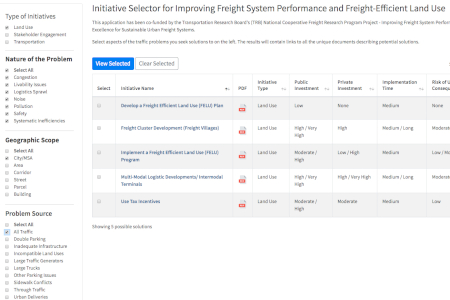
Initiative Selector

OVERVIEW

This project focuses on freight systems as a crucial economic and quality of life contributor, and a major source of environmental pollution, unwanted noise, and safety hazards. The primary goal of this project is to improve the overall performance of the urban freight industry.

The project will define a pragmatic and conceptually well-grounded planning guide that includes both supply and demand strategies (including hybrids), that is supported by solid guidelines to establish effective and proactive stakeholder engagement processes and software tools to estimate freight trip generation in urban areas. The project will provide practitioners with comprehensive, pragmatic, and actionable guidelines on how to plan, design, and implement both supply and demand strategies.

The public sector strategies (both supply and demand side) to be considered in the project will seek to achieve one or several of the following objectives:

  • Reduce Congestion: Public agencies seek to reduce delays by either increasing capacity (which may induce demand and a return of congestion in the long term) or managing demand. This is an important objective because congestion delays are correlated with air pollution externalities, as well as economic inefficiency.
  • Environmental Sustainability: The desire is to minimize environmental impacts, e.g., emissions, associated with freight activity. Often correlated with congestion reduction, it is not necessarily a cause and effect relationship; for instance, fostering the use of alternative fuels, efficient engines, and electric trucks reduces environmental impacts without impacting congestion.
  • Enhance Safety: The main intent is to reduce the risk/severity of accidents. This is an important objective, particularly for local communities that tend to think of freight activity as the cause of traffic accidents.
  • Enhance Security: In this case, transportation decision makers are looking to improve the ability of the freight system to repel security attacks that may compromise life and property, and to enhance the resiliency of the system to manmade or natural threats.
  • Enhance Economic Competitiveness: The desired intent here is to foster economic activity in the study area. For instance, by means of freight-friendly land use policies, or by enhancing the efficiency of freight related economic activities.
  • Revenue Generation: Increasingly transportation agencies are seeking to use fees and other forms of payment transfers to generate funds that can enhance the capabilities of the metropolitan area to perform its duties.
  • Enhance Livability: These considerations seek to preserve the community culture, foster a positive synergy between business and residents, and seamlessly integrate freight activity into the fabric of the local communities.

KEY TASKS

  • Identify and Summarize Applicable Research
  • Identify Strategies and Initiate Stakeholder Engagement
  • Identify Obstacles and Successes
  • Prepare Interim Report
  • Develop a Draft Planning Guide
  • Develop Software Tool to Estimate Freight Trip Generation
  • Gather Input from Stakeholders
  • Revise the Draft Planning Guide
  • Conduct Workshop
  • Finalize and Disseminate the Planning Guide
  • Produce Final Report

KEY FINDINGS

  • FG and FTG are very different concepts: their modeling approaches follow different principles
  • Using constant FTG rates is bound to produce large estimation errors
  • Employment and establishment area are good variables to explain FG and FTG
  • The type of economic activity is a key variable to estimate FTG
  • Industry sectors are better proxies of economic activities than land use
  • The aggregation procedure should be determined according to the disaggregated model specification

KEY PRODUCTS

  • NCFRP Report 33
  • Initiative Selector
  • Freight and Service Activity Generation Software

ADDITIONAL PRODUCTS

  • Holguín-Veras, J., Amaya, J., Sanchez-Diaz, I., Gonzalez-Calderon, C., Jaller, M., Wojtowicz, J., Wang, C., Browne, M., Hodge S., and Rhodes, S. Strategies to Improve Urban Freight Systems
  • Presentation at the INFORMS Annual Meeting in Minneapolis, MN
  • Presentation at the Fifth International Urban Freight Conference INUF-METRANS in Long Beach, CA

CONTRIBUTING TEAM MEMBERS

  • José Holguín-Veras
  • Cara Wang
  • Johanna Amaya Leah
  • Jeffrey Wojtowicz
  • Ivan Sanchez-Diaz
  • Carlos González-Calderón
  • Miguel Jaller

RELATED PROJECTS

  • Effective Decision-Making Methods for Freight-Efficient Land Use
  • Collaborative Approaches to Foster Energy-Efficient Logistics in the Albany-New York City Corridor

Freight Transportation Cost Data Element

October 9, 2019 By admin

Freight Transportation Cost Data Element

START YEAR: 2010

COMPLETION YEAR: 2012

TOPIC(S): Freight Modeling

PRIMARY CONTACT(S):

  • José Holguín-Veras,
  • Jeffrey Wojtowicz

PARTNER(S):

  • Jack Faucett Associates, Inc.,
  • A. Strauss-Wieder, Inc.,
  • TNO

SPONSORS/FUNDING:

  • The National Cooperative Freight Research Program Project 26 (NCFRP 26)
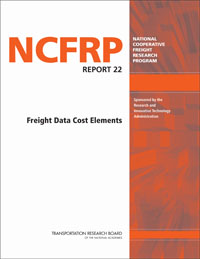
NCFRP Report 22

OVERVIEW

Freight Data Cost Elements identifies the specific types of direct freight transportation cost data elements required for public investment, policy, and regulatory decision-making. The report also describes and assesses different strategies for identifying and obtaining the needed cost data elements. The key objectives of the project are to:

  • Identify the specific types of direct freight transportation cost data elements required for public investment, policy, and regulatory decision-making; and
  • Describe and assess the different strategies needed to identify and obtain these cost data elements

KEY TASKS

  • Identify and describe the state of the practice for current multimodal freight transportation cost data uses, sources, methods, collection strategies, and data elements for public-sector planning and decision-making
  • Identify current and evolving public-sector freight transportation planning and decision-making functions and the cost data currently used, or that might be used, to support those functions. Describe the key freight transportation cost data elements required for public-sector planning and decision-making
  • Identify primary and secondary freight transportation cost data sources and assess their applicability to the key requirements identified in Task 2. Discuss data issues and limitations, including data accuracy, privacy, antitrust issues and other constraints, as well as conceptual collection strategies. Discuss methods for closing any identified gaps
  • Identify available cost estimation tools, methods, and procedures, and their applicability to the key requirements identified in Task 3. Discuss strengths and weaknesses and identify methods for closing any gaps
  • Submit a final report that (1) identifies the specific types of direct freight transportation cost data elements required for public investment, policy, and regulatory decision-making and (2) describes and assesses different strategies for identifying and obtaining the needed cost data elements

KEY FINDINGS

  • FG and FTG are very different concepts: their modeling approaches follow different principles
  • Using constant FTG rates is bound to produce large estimation errors
  • Employment and establishment area are good variables to explain FG and FTG
  • The type of economic activity is a key variable to estimate FTG
  • Industry sectors are better proxies of economic activities than land use
  • The aggregation procedure should be determined according to the disaggregated model specification

KEY PRODUCTS

  • NCFRP Report 22

ADDITIONAL PRODUCTS

CONTRIBUTING TEAM MEMBERS

  • Carlos González-Calderón

RELATED PROJECTS

Freight Trip Generation and Land Use

October 4, 2019 By admin

Freight Trip Generation and Land Use

START YEAR: 2009

COMPLETION YEAR: 2015

TOPIC(S): Freight Modeling

PRIMARY CONTACT(S):

  • José Holguín-Veras,
  • Jeffrey Wojtowicz

PARTNER(S):

  • University at Albany,
  • TNO Delft,
  • Herbert Levinson,
  • Erica Levine Powers, Esq., (J.D., LL.M. Taxation)

SPONSORS/FUNDING:

  • The National Cooperative Freight Research Program Project 25 (NCFRP 25),
  • The National Cooperative Freight Research Program Project 25(01) (NCFRP 25(01)),
  • The National Cooperative Highway Research Program Project 08-80 (NCHRP 08-80)
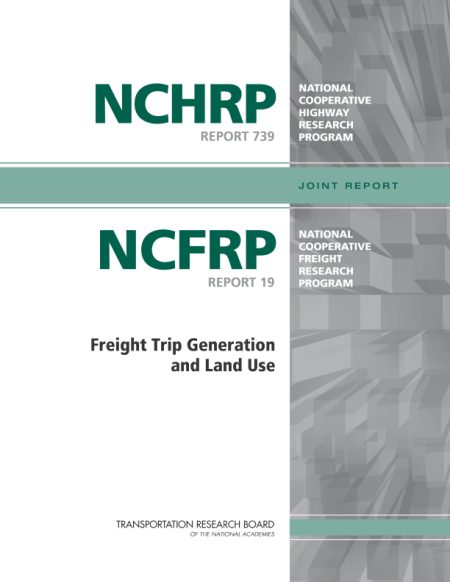
NCHRP Freight Generation Project

OVERVIEW

The current transportation planning process does not effectively estimate freight activity necessary to assist decision makers when making infrastructure choices. This research seeks to provide improved freight generation (FG) and freight trip generation (FTG) models for different land use characteristics related to freight facilities and commercial operations to better inform state and local decision-making. Freight generation models are estimated using the largest and most complete establishment-based freight survey in the world (with 100,000 establishments samples): the Commodity Flow Survey.

KEY TASKS

  • Develop FG models based on the Commodity Flow Survey micro-data
  • Compilation of an online relational database of FTG models
  • Design a survey prototype for establishments based data collection
  • Propose a synthetic correction of trip rates used in the literature to compute FTG
  • Develop a set of case studies to estimate FTG models and assess their transferability 

KEY FINDINGS

  • FG and FTG are very different concepts: their modeling approaches follow different principles
  • Using constant FTG rates is bound to produce large estimation errors
  • Employment and establishment area are good variables to explain FG and FTG
  • The type of economic activity is a key variable to estimate FTG
  • Industry sectors are better proxies of economic activities than land use
  • The aggregation procedure should be determined according to the disaggregated model specification

KEY PRODUCTS

  • NCFRP Report 19 / NCHRP Report 739
  • NCFRP Report 37
  • Freight and Service Activity Generation Software

ADDITIONAL PRODUCTS

Holguín-Veras, J., M. Jaller, L. Destro, X. Ban, C. Lawson and H. Levinson (2011). “Freight Generation, Freight Trip Generation, and the Perils of Using Constant Trip Rates.” Transportation Research Record 2224: 68-81. 10.3141/2224-09

Holguín-Veras, J., I. Sánchez-Díaz, C. Lawson, M. Jaller, S. Campbell, H. S. Levinson and H. S. Shin (2013). “Transferability of Freight Trip Generation Models.” Transport Research Record (in print).

Lawson, C., J. Holguín-Veras, I. Sánchez-Díaz, M. Jaller, S. Campbell and E. Powers (2012). “Estimated Generation of Freight Trips Based on Land Use.” Transportation Research Record 2269: 65-72. 10.3141/2269-08

CONTRIBUTING TEAM MEMBERS

  • Miguel Jaller,
  • Iván Sánchez-Díaz,
  • Shama Campbell

RELATED PROJECTS

  • « Go to Previous Page
  • Go to page 1
  • Go to page 2
  • Go to page 3

Copyright © 2026 Rensselaer Polytechnic Institute (RPI)

Media Policy    |    Web Privacy Policy    |    Student Consumer Information    |    Title IX Policy    |    Accessibility