
• Skip to primary navigation
  • Skip to main content

Center for Infrastructure, Transportation, and the Environment (CITE)

Rensselaer Polytechnic Institute SEARCH
School of Engineering
Center for Infrastructure, Transportation, and the Environment (CITE)
  • About Us
  • Team
  • News
  • Training & Outreach
  • Research
  • Software & Tools
  • CoE-SUFS
    • Peer-to-Peer Exchange Program
  • Contact Us

Freight Transportation

Freight Transportation Cost Data Element

October 9, 2019 By admin

Freight Transportation Cost Data Element

START YEAR: 2010

COMPLETION YEAR: 2012

TOPIC(S): Freight Modeling

PRIMARY CONTACT(S):

  • José Holguín-Veras,
  • Jeffrey Wojtowicz

PARTNER(S):

  • Jack Faucett Associates, Inc.,
  • A. Strauss-Wieder, Inc.,
  • TNO

SPONSORS/FUNDING:

  • The National Cooperative Freight Research Program Project 26 (NCFRP 26)
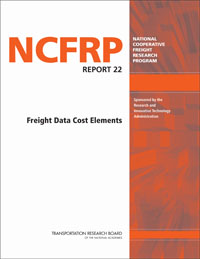
NCFRP Report 22

OVERVIEW

Freight Data Cost Elements identifies the specific types of direct freight transportation cost data elements required for public investment, policy, and regulatory decision-making. The report also describes and assesses different strategies for identifying and obtaining the needed cost data elements. The key objectives of the project are to:

  • Identify the specific types of direct freight transportation cost data elements required for public investment, policy, and regulatory decision-making; and
  • Describe and assess the different strategies needed to identify and obtain these cost data elements

KEY TASKS

  • Identify and describe the state of the practice for current multimodal freight transportation cost data uses, sources, methods, collection strategies, and data elements for public-sector planning and decision-making
  • Identify current and evolving public-sector freight transportation planning and decision-making functions and the cost data currently used, or that might be used, to support those functions. Describe the key freight transportation cost data elements required for public-sector planning and decision-making
  • Identify primary and secondary freight transportation cost data sources and assess their applicability to the key requirements identified in Task 2. Discuss data issues and limitations, including data accuracy, privacy, antitrust issues and other constraints, as well as conceptual collection strategies. Discuss methods for closing any identified gaps
  • Identify available cost estimation tools, methods, and procedures, and their applicability to the key requirements identified in Task 3. Discuss strengths and weaknesses and identify methods for closing any gaps
  • Submit a final report that (1) identifies the specific types of direct freight transportation cost data elements required for public investment, policy, and regulatory decision-making and (2) describes and assesses different strategies for identifying and obtaining the needed cost data elements

KEY FINDINGS

  • FG and FTG are very different concepts: their modeling approaches follow different principles
  • Using constant FTG rates is bound to produce large estimation errors
  • Employment and establishment area are good variables to explain FG and FTG
  • The type of economic activity is a key variable to estimate FTG
  • Industry sectors are better proxies of economic activities than land use
  • The aggregation procedure should be determined according to the disaggregated model specification

KEY PRODUCTS

  • NCFRP Report 22

ADDITIONAL PRODUCTS

CONTRIBUTING TEAM MEMBERS

  • Carlos González-Calderón

RELATED PROJECTS
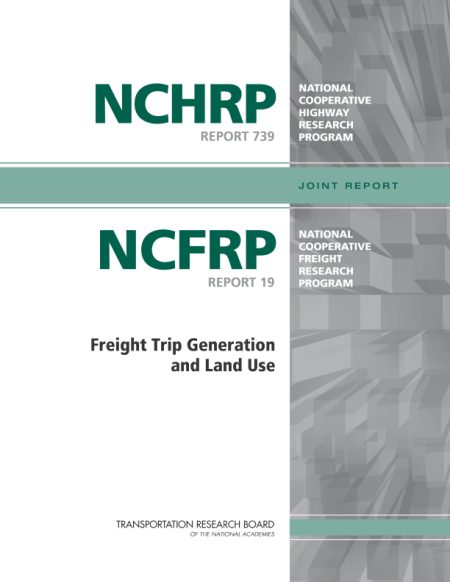
Freight Trip Generation and Land Use

October 4, 2019 By admin

Freight Trip Generation and Land Use

START YEAR: 2009

COMPLETION YEAR: 2015

TOPIC(S): Freight Modeling

PRIMARY CONTACT(S):

  • José Holguín-Veras,
  • Jeffrey Wojtowicz

PARTNER(S):

  • University at Albany,
  • TNO Delft,
  • Herbert Levinson,
  • Erica Levine Powers, Esq., (J.D., LL.M. Taxation)

SPONSORS/FUNDING:

  • The National Cooperative Freight Research Program Project 25 (NCFRP 25),
  • The National Cooperative Freight Research Program Project 25(01) (NCFRP 25(01)),
  • The National Cooperative Highway Research Program Project 08-80 (NCHRP 08-80)
NCHRP Freight Generation Project

OVERVIEW

The current transportation planning process does not effectively estimate freight activity necessary to assist decision makers when making infrastructure choices. This research seeks to provide improved freight generation (FG) and freight trip generation (FTG) models for different land use characteristics related to freight facilities and commercial operations to better inform state and local decision-making. Freight generation models are estimated using the largest and most complete establishment-based freight survey in the world (with 100,000 establishments samples): the Commodity Flow Survey.

KEY TASKS

  • Develop FG models based on the Commodity Flow Survey micro-data
  • Compilation of an online relational database of FTG models
  • Design a survey prototype for establishments based data collection
  • Propose a synthetic correction of trip rates used in the literature to compute FTG
  • Develop a set of case studies to estimate FTG models and assess their transferability 

KEY FINDINGS

  • FG and FTG are very different concepts: their modeling approaches follow different principles
  • Using constant FTG rates is bound to produce large estimation errors
  • Employment and establishment area are good variables to explain FG and FTG
  • The type of economic activity is a key variable to estimate FTG
  • Industry sectors are better proxies of economic activities than land use
  • The aggregation procedure should be determined according to the disaggregated model specification

KEY PRODUCTS

  • NCFRP Report 19 / NCHRP Report 739
  • NCFRP Report 37
  • Freight and Service Activity Generation Software

ADDITIONAL PRODUCTS

Holguín-Veras, J., M. Jaller, L. Destro, X. Ban, C. Lawson and H. Levinson (2011). “Freight Generation, Freight Trip Generation, and the Perils of Using Constant Trip Rates.” Transportation Research Record 2224: 68-81. 10.3141/2224-09

Holguín-Veras, J., I. Sánchez-Díaz, C. Lawson, M. Jaller, S. Campbell, H. S. Levinson and H. S. Shin (2013). “Transferability of Freight Trip Generation Models.” Transport Research Record (in print).

Lawson, C., J. Holguín-Veras, I. Sánchez-Díaz, M. Jaller, S. Campbell and E. Powers (2012). “Estimated Generation of Freight Trips Based on Land Use.” Transportation Research Record 2269: 65-72. 10.3141/2269-08

CONTRIBUTING TEAM MEMBERS

  • Miguel Jaller,
  • Iván Sánchez-Díaz,
  • Shama Campbell

RELATED PROJECTS

  • « Go to Previous Page
  • Go to page 1
  • Go to page 2
  • Go to page 3

Copyright © 2025 Rensselaer Polytechnic Institute (RPI)

Media Policy    |    Web Privacy Policy    |    Student Consumer Information    |    Title IX Policy    |    Accessibility